
99.999%
Maximum SiO₂ Purity
1683°C
Softening Point Threshold
<0.02mm
Precision Ground Stem Tolerance
100%
TÜV Rheinland Inspected
Brunauer-Emmett-Teller (BET) Surface Metrology: The Criticality of Quartz Integrity
Specific surface area analysis and pore size distribution measurements governed by the Brunauer-Emmett-Teller (BET) adsorption isotherm model (ISO 9277 / ASTM D3663) rely upon sub-microtorr vacuum degas protocols and precise cryo-adsorption of inert adsorptive gases (typically Nitrogen at 77.35 K, Argon at 87.27 K, or Krypton at 77.35 K for low specific-surface-area matrices). In high-precision physisorption instruments manufactured by Micromeritics (e.g., 3Flex, ASAP series), Microtrac MRB (BELSORP MAX X, mini II), and Anton Paar (Autosorb iQ), the sample vessel is an active analytical boundary condition, not merely a containment holder.
Vulra Quartz designs and manufactures OEM/ODM BET quartz tubes from natural crystal fused silica quarried and refined in Donghai, Jiangsu Province. By controlling thermal deformation, coefficient of thermal expansion (CTE), and trace elemental leaching, our custom quartz sample cells eliminate the systematic baseline drifts that commonly plague material characterization laboratories across Malaysia's semiconductor, oleochemical, and advanced catalysis sectors.
Thermal Shock Resistance across Cryogenic-to-Pyrolysis Cycling
BET sample preparation mandates rigorous in-situ or external thermal outgassing—often driving samples to temperatures between 350°C and 1050°C under turbomolecular dry vacuum (<10⁻⁶ mbar) to evacuate chemisorbed moisture, atmospheric volatile organic hydrocarbons, and interstitial carbonaceous remnants. Immediately subsequent to degas verification, the sample cell is plunged into a liquid nitrogen dewars operating at -196°C (77 K) for relative pressure ($P/P_0$) equilibrium scanning.
Standard borosilicate glass sample cells experience structural failure or progressive micro-fracturing under this thermal delta ($\Delta T > 500^\circ\text{C}$) due to its comparatively high linear CTE ($3.3 \times 10^{-6}/\text{K}$). In contrast, Vulra's fused quartz features an ultra-low linear thermal expansion coefficient of $5.5 \times 10^{-7}/\text{K}$ (0–1000°C). This near-zero dimensional shift ensures zero micro-fissuring, uncompromised structural tensile strength ($\approx 48\text{ N/mm}^2$), and absolute wall hermeticity over hundreds of continuous degas-cryo cycles.
| Physical / Chemical Property | Semiconductor-Grade Fused Quartz | Standard Lab-Grade Quartz | Borosilicate 3.3 Reference |
|---|---|---|---|
| SiO₂ Chemical Purity | ≥ 99.999% (≤ 15 ppm total trace metals) | ≥ 99.99% (≤ 50 ppm total impurities) | ≈ 81% SiO₂ (Contains B₂O₃, Na₂O, Al₂O₃) |
| Hydroxyl (OH⁻) Ion Content | ≤ 5 ppm (Vacuum Dehydroxylated) | ≤ 15–30 ppm | > 200 ppm bound silanols |
| Thermal Expansion (0–1000°C) | $5.4 \times 10^{-7} \text{ K}^{-1}$ | $5.5 \times 10^{-7} \text{ K}^{-1}$ | $3.3 \times 10^{-6} \text{ K}^{-1}$ |
| Continuous Operating Temp | 1150°C (Short peak: 1450°C) | 1100°C (Short peak: 1350°C) | 450°C (Max safe continuous) |
| Helium Permeation (20°C) | ≤ $2.1 \times 10^{-10} \text{ cm}^3 \cdot \text{mm} / (\text{cm}^2 \cdot \text{s} \cdot \text{bar})$ | ≤ $3.0 \times 10^{-10} \text{ cm}^3 \cdot \text{mm} / (\text{cm}^2 \cdot \text{s} \cdot \text{bar})$ | Noticeable diffusion background |
| Softening Point ($\log \eta = 7.6$) | 1683°C | 1650°C | 820°C |
Dehydroxylation & Suppression of Vacuum Degas Outgassing
In low-pressure Krypton sorption measurements designed for thin films, low-surface-area silicon wafers, or microporous metal-organic frameworks (MOFs), secondary internal outgassing from the sample vessel walls introduces critical error into manifold pressure transducers. Silanol (Si-OH) groups bonded to internal quartz walls dissociate under ultra-high vacuum at temperatures exceeding 450°C, releasing trace $H_2O$ molecules that falsely inflate volumetric intake calculations.
Vulra Quartz mitigates this phenomenon through proprietary vacuum-induction thermal dehydroxylation. Our BET test tubes undergo prolonged vacuum furnace baking at 1050°C prior to final calibration, reducing internal hydroxyl content to <5 ppm. The resulting quartz envelope exhibits exceptional chemical inertness and zero baseline void-volume drift during ultra-sensitive multi-point BET isotherms.
Penang Advanced Semiconductor & OSAT Cluster
Within the Bayan Lepas Free Industrial Zone and Batu Kawan Industrial Park, semiconductor packaging, outsourced assembly, and testing (OSAT) giants utilize automated physisorption analyzers to evaluate the specific surface area and micro-porosity of epoxy molding compounds (EMC), underfills, thermal interface materials (TIM), and atomic layer deposition (ALD) high-$\kappa$ dielectric precursor coatings. Vulra's precision ground-stem BET tubes ensure a leak-tight connection with Viton and Kalrez vacuum manifold O-rings, eliminating ambient air leakage in Penang's coastal humidity environments.
Oleochemical & Biofuel Catalyst Plants (Selangor & Johor)
Malaysia is a global powerhouse for palm oil-based oleochemicals and renewable biodiesel. Facilities throughout Pasir Gudang, Tanjung Langsat, and Port Klang continuously evaluate heterogeneous hydrodeoxygenation catalysts, modified zeolites, activated bleaching earths, and palm shell-derived porous activated carbon. Characterizing micro-pore (pore diameter <2 nm) and meso-pore (2–50 nm) volume requires degassing samples at sustained temperatures above 400°C without risk of tube collapse under sub-millibar atmospheric pressures.
Petronas & Tier-1 Academic Characterization Labs
Advanced laboratories at Universiti Malaya (UM), Universiti Sains Malaysia (USM), Universiti Teknologi Malaysia (UTM), and PETRONAS Research Sdn Bhd (PRSB) drive breakthrough research in Carbon Capture, Utilization, and Storage (CCUS). Synthesizing novel Metal-Organic Frameworks (MOFs) and Covalent Organic Frameworks (COFs) for selective $CO_2$ and $CH_4$ adsorption requires custom quartz bulb tubes with localized sample containment volumes (from 1 cm³ to 12 cm³) matched precisely to limited milligram-scale research yields.
Strategic Alignment with Malaysia's Industrial Roadmap: NIMP 2030 & ESG Imperatives
Malaysia's New Industrial Master Plan (NIMP 2030) actively prioritizes front-end wafer fabrication, compound semiconductor development (Silicon Carbide and Gallium Nitride), advanced electric vehicle (EV) battery localized supply chains, and green hydrogen electrolyzer development. These sunrise high-tech sectors place unprecedented technical demands on analytical lab consumables:
Anode / Cathode Active Material Characterization
EV battery gigafactory developments in Kedah and Perak require strict BET nitrogen physisorption QC testing on synthetic graphite, silicon-carbon composite anodes, and high-nickel NMC cathode chemistries to confirm surface area ratios that govern C-rate performance and solid-electrolyte interphase (SEI) stability.
Compound Semiconductor Defect Mapping
Next-generation SiC and GaN power device foundries expanding in Kulim Hi-Tech Park (KHTP) rely on pure fused silica quartz components to safeguard chemical vapor deposition (CVD) high-temperature vacuum lines from alkali-metal cross-contamination (Sodium, Potassium, Calcium).
Industrial Cleanliness & Extreme Vacuum Stability
Advanced BET tubes destined for precision testing must withstand mechanical clamping forces in automated autosamplers while resisting chemical etch from volatile corrosive acid vapors released during pre-analysis outgassing.
Oxy-Hydrogen Lathe Hot Working
High-precision micro-flame sealing, hemispherical bulb blowing, and uniform wall formation. Eliminates stress-concentrating micro-bubbles and ensures wall thickness uniformity (±0.05 mm) along the entire tube body to maintain constant thermal conductivity during liquid nitrogen immersion.
Precision Ground Joints & Manifold Interfaces
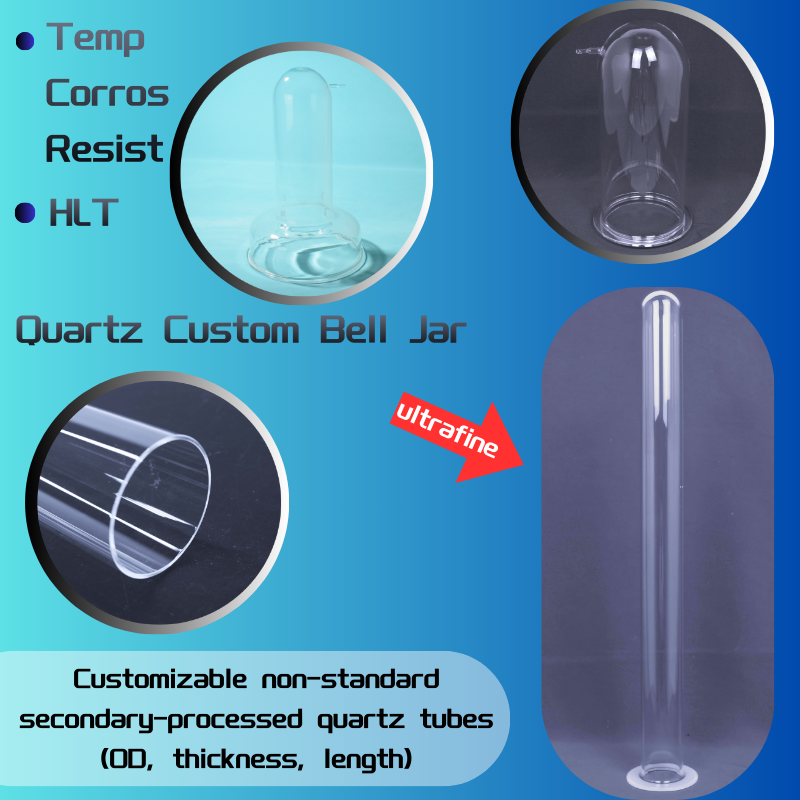
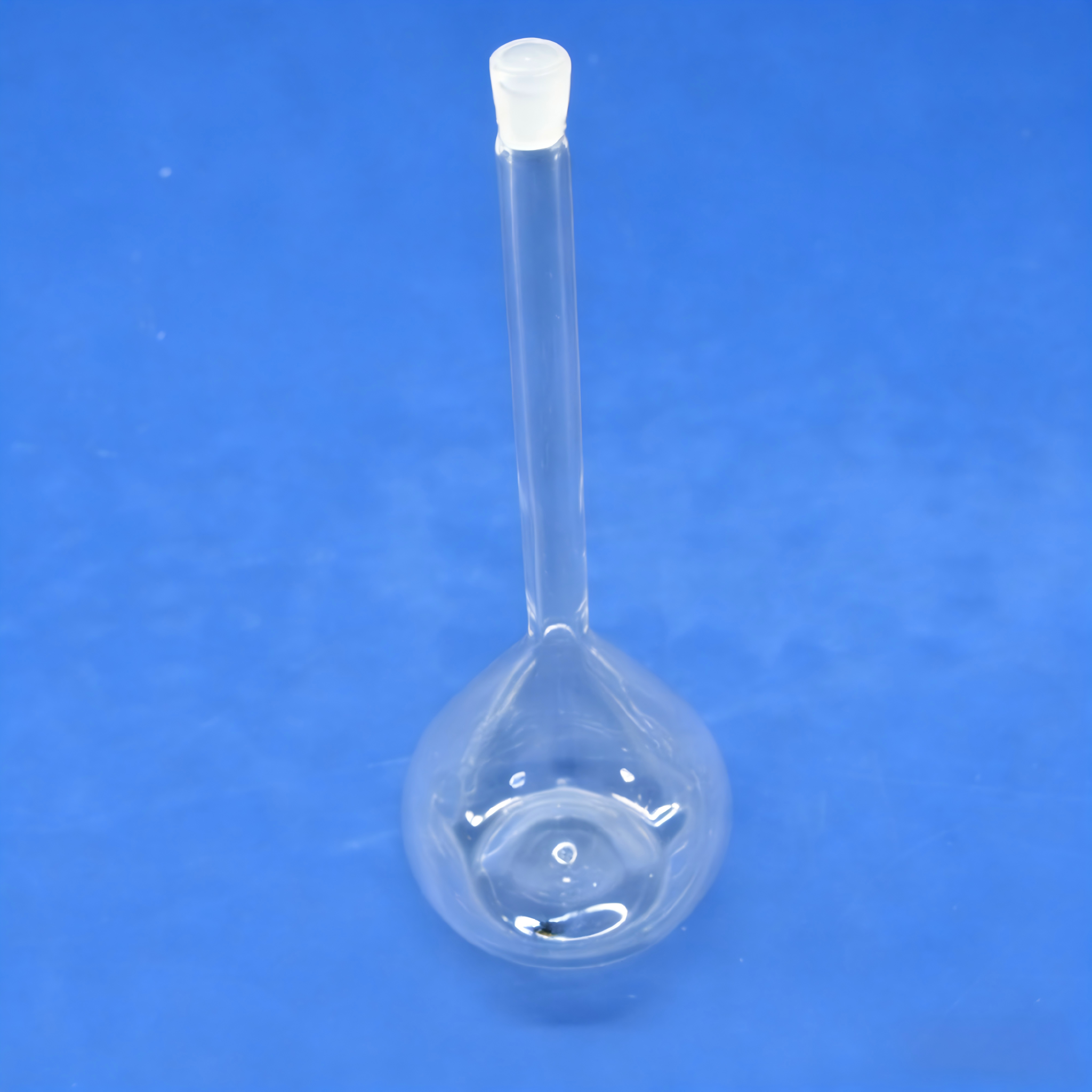
CNC diamond-tool grinding produces precision outer diameter stems (6 mm, 9 mm, 12 mm, 1/2-inch) compatible with instrument quick-connect fittings. Ground taper joints (such as 10/18, 14/20, or spherical ball joints) guarantee vacuum tightness down to $1 \times 10^{-7}$ Torr without silicone grease.
Annealing & Triple-Stage Acid Pickling
Every fabricated component undergoes computer-controlled thermal annealing at 1150°C to release lingering mechanical stress generated during flame bending. Post-annealing, parts pass through HF/HNO₃ acid bath immersion and 18.2 M$\Omega\cdot$cm deionized water rinses to remove trace surface cations.
Are Vulra BET quartz tubes 100% interchangeable with OEM parts from Micromeritics, Microtrac (BELSORP), and Anton Paar?
Yes. We precision-engineer our sample tubes according to verified standard dimensional interfaces. We produce 6 mm, 9 mm, 12 mm, and 1/2-inch straight-stem tubes, bulb cells (from 1 cm³ to 12 cm³ capacity), cylindrical cells, flat-bottom cells, and bypass double-path elbow cells. Whether your system utilizes standard O-ring compression seals or ground joints, our dimensions conform to micrometer tolerances (≤ ±0.05 mm), ensuring zero leak alarms during vacuum calibration.
How does Vulra safeguard brittle quartzware against transit fracture and tropical moisture during sea/air export to Malaysia?
We employ an engineered export-grade packaging system. Each quartz item is sealed in high-density polyethylene antistatic vacuum bags with desiccant sachets to prevent ambient tropical moisture chemisorption during ocean or air transit. The bagged items are encased in form-molded shock-absorbing EPE closed-cell foam inserts, placed in dual-wall corrugated internal boxes, and secured inside export-grade non-fumigation plywood crates. We guarantee 100% damage-free delivery to doorsteps across Penang, Klang Valley, Johor Bahru, and Sarawak.
What documentation and import tariff considerations apply to importing fused quartz consumables into Malaysia?
Our quartz tubes typically import under HS Code 7017.10 (Laboratory, hygienic or pharmaceutical glassware, of fused quartz or other fused silica). Under the ASEAN-China Free Trade Area (ACFTA), we can provide a Form E Certificate of Origin upon buyer request, allowing qualifying Malaysian importers to benefit from preferential tariff rates (often 0% customs import duty). Malaysian Sales and Service Tax (SST) exemptions can also be supported when processing through MIDA-approved LMW (Licensed Manufacturing Warehouse) or Free Industrial Zone (FIZ) entities.
What is your Minimum Order Quantity (MOQ) for non-standard custom sample tube dimensions?
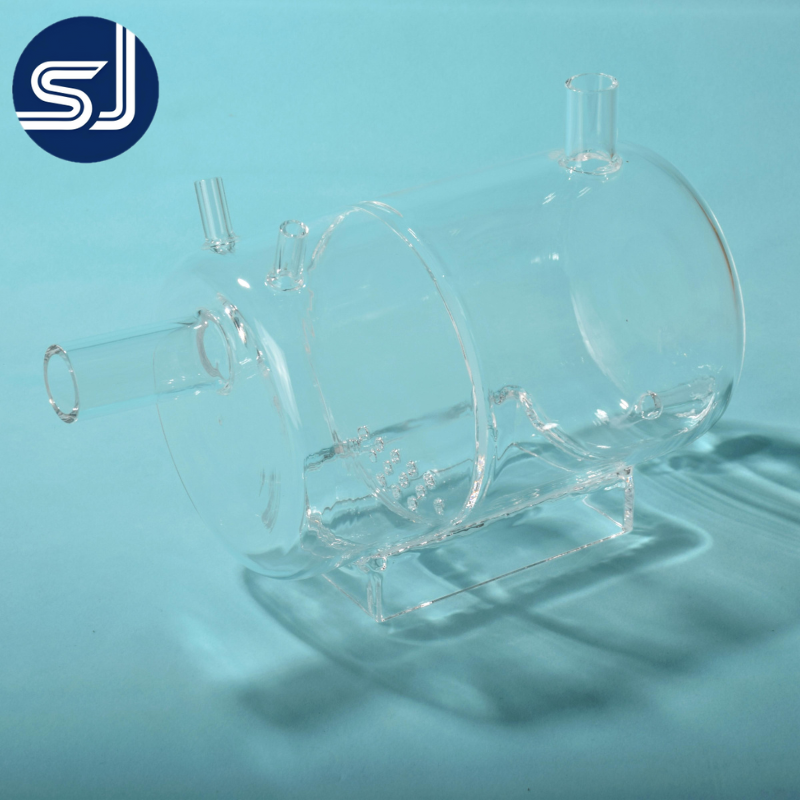
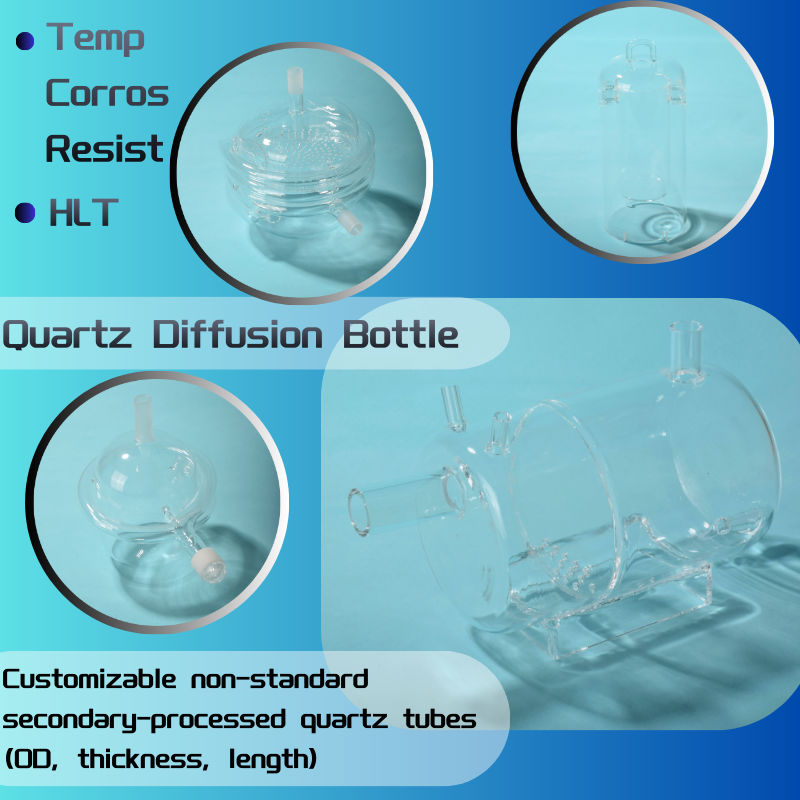
For drawing-customized BET tubes, non-standard ground interfaces, flow-splitting sample bottles, or quartz reaction vessels, our MOQ starts from just 1 piece for prototype verification. For standard batch production and recurrent annual supply contracts, typical batch packaging quantities range between 5 to 50 pieces per shipping carton.
Can Vulra provide custom calibration volumes or internal filling rods (filler rods) to minimize dead volume?
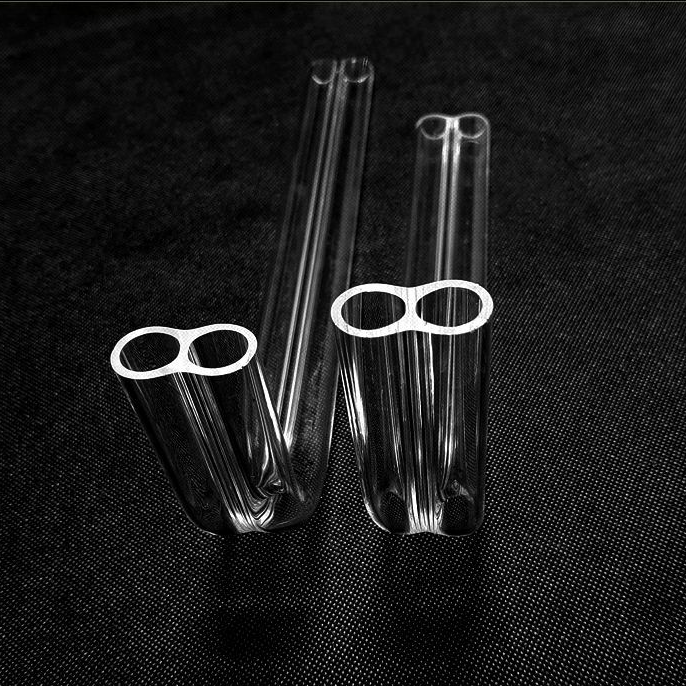
Yes. Precise free-space (dead volume) minimization is critical for high-resolution micropore scanning and Krypton gas physisorption. We fabricate matching high-purity solid quartz filler rods matched to your sample tube internal diameter with clearances of 0.2–0.4 mm, complete with top retention collars or handles for safe insertion and retrieval.
Accelerate Your Surface Characterization Accuracy
Consult with our quartz engineering team today. Send us your technical drawings, equipment model references, or purity requirements for a rapid feasibility analysis and competitive OEM factory-direct quotation.