Standard & Custom Fabricated Quartz Components
Explore our high-purity fused silica solutions tailored for spectrophotometric analysis, electrochemistry cells, high-temperature reactors, and vacuum systems.

Optical Metrology, Molecular Fusion, and Transmittance Physics of Fused Quartz Cuvettes
An authoritative analysis of optical cell fabrication, material chemistry, and photometric accuracy designed for principal investigators, QA/QC directors, and analytical laboratory technicians.
1. The Physics of Spectrophotometric Accuracy: Why Optical Material Selection Dictates Baseline Stability
In analytical spectrophotometry (UV-Vis-NIR), spectrophotometer cuvettes (absorption cells) serve as the physical interface between the monochromatic photon beam and the absorbing analyte. The fundamental relationship governing this interaction is the Beer-Lambert Law ($A = \varepsilon \cdot c \cdot l$). When measuring trace analytes, enzymatic kinetics, protein quantification (A280/A260), or nanomaterial dispersion, any optical variation introduced by the cuvette itself directly degrades analytical limit of detection (LOD) and limit of quantitation (LOQ).
Standard optical glass or polystyrene cuvettes exhibit steep cutoff bands below 340 nm due to internal metallic impurities and polymer molecular absorption. Consequently, UV-range spectrophotometry requires high-purity fused silica (synthetic fused quartz). At Vulra Quartz, our manufacturing processes prioritize synthetic fused silica grades (such as JGS1) and natural optical fused quartz (JGS2), ensuring negligible trace impurities (Fe < 0.2 ppm, Al < 5 ppm, Cu < 0.05 ppm). This structural purity eliminates parasitic absorbance spikes and prevents solarization when exposed to intense deuterium ($D_2$) or xenon flash arc illumination.
Technical Insight: Fused quartz cuvettes manufactured using organic adhesives or low-temperature epoxies frequently fail in organic solvent environments (e.g., DMSO, tetrahydrofuran, hexane, or dimethylformamide). Vulra Quartz utilizes exclusively high-temperature optical contact thermal fusion (sintering). This direct glass-to-glass atomic coalescence forms a monolithic molecular bond without chemical cements, ensuring absolute solvent insolubility and vacuum hermeticity.
2. Window Flatness, Pathlength Parallelism, and Wavefront Distortion
A frequent root cause of photometric error in dual-beam spectrophotometers is non-parallel optical windows or surface micro-roughness. In our Donghai manufacturing hub, every optical window blank undergoes multi-stage double-sided lap-polishing. Surfaces are inspected via He-Ne laser interferometry at 632.8 nm to verify wavefront distortion below $\lambda/4$ over the complete aperture.
Optical pathlength tolerance is maintained within ±0.005 mm for standard 10 mm pathlength cells, far exceeding the requirements of DIN 58963 and ISO standards. This parallelism prevents chromatic refraction and ensures that the light beam passes perpendicularly through the liquid sample without stray light scatter hitting the photodiode or PMT detector array.
| Physical / Optical Parameter | UV Synthetic Quartz (JGS1 Grade) | Standard Optical Fused Quartz (JGS2) | Industrial Borosilicate Glass (Reference) |
|---|---|---|---|
| Useful Spectral Range | 190 nm – 2500 nm (Far UV to NIR) | 220 nm – 2500 nm (Near UV to NIR) | 340 nm – 2500 nm (Visible only) |
| UV Transmittance @ 200 nm (Empty Cell) | > 82.5% (Internal transmission > 90%) | > 70.0% | 0.0% (Complete UV opacity) |
| Standard Pathlength Tolerance | ± 0.005 mm (10 mm standard cell) | ± 0.010 mm | ± 0.020 mm |
| Window Wavefront Flatness | λ / 4 at 632.8 nm | λ / 2 at 632.8 nm | λ to 2λ |
| Thermal Expansion Coeff. (20–300 °C) | $5.5 \times 10^{-7} \text{ K}^{-1}$ | $5.5 \times 10^{-7} \text{ K}^{-1}$ | $33 \times 10^{-7} \text{ K}^{-1}$ |
| Window Bonding Methodology | Atomic Direct Fusion / Optical Contact | High-Temp Thermal Sintering | Adhesive Epoxy / Fritted Glass |
| Solvent & Acid Resistance | Unaffected by Aqua Regia, DMSO, Acetonitrile | Unaffected by acids (except HF) | Vulnerable to leaching & adhesive swelling |
3. Photometric Matching and Transmission Pairing
In high-precision quantitative analysis, mismatched cuvette pairs can introduce up to 2-3% systematic absorbance offset. Vulra Quartz offers calibrated cell pairing services. Using dual-beam spectrophotometers with reference standards traceable to NIST and DAkkS, cells are evaluated across the 200 nm, 240 nm, 280 nm, and 546 nm bands. Matched pairs are guaranteed to exhibit transmission divergence ($\Delta T$) of less than 0.5% across the entire UV-Vis bandwidth, providing analytical laboratories with seamless baseline zeroing without software interpolation.
Precision Quartz Applications Across Gothenburg's Innovation Hubs
Serving the specific analytical, biopharmaceutical, and marine research demands of the Västra Götaland ecosystem with direct shipping to Gothenburg Port and Landvetter Airport.
Biopharma R&D at AstraZeneca BioVentureHub & Sahlgrenska
Crucial for oligonucleotide purity determination, DNA/RNA A260/A280 ratios, and monoclonal antibody aggregation kinetics. Our ultra-micro cuvettes (sample volume down to 50 μL) preserve precious mammalian cell culture fractions while delivering optimal optical throughput.
Chalmers Materials Analysis Laboratory (CMAL) Nanotechnology
Supporting advanced surface plasmon resonance (SPR), photocatalytic water splitting, and 2D material characterization. Our precision optical windows and dome electrochemical cells withstand harsh electrolytes and laser illumination without solarization.
Marine & Environmental Analytics (Kattegat & Göta Älv)
Employed by oceanographic and environmental laboratories monitoring dissolved organic carbon (DOC), microplastic UV-photodegradation, and heavy metal colorimetric complexes in the brackish waters of the Gothenburg archipelago.
Battery Cell Chemistry & Sustainable Mobility (RISE)
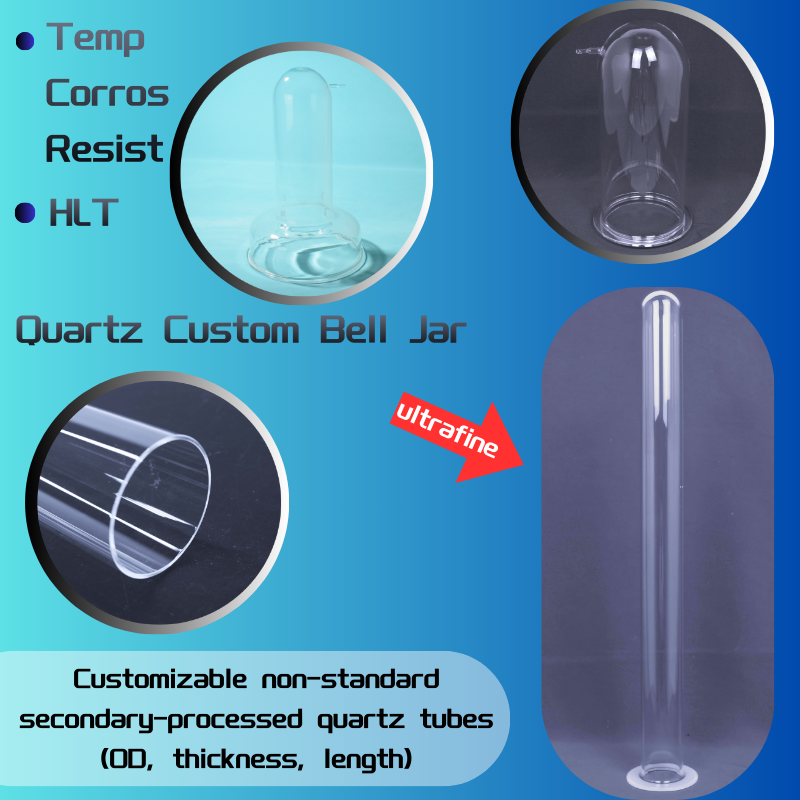
Supporting next-generation lithium-ion, sodium-ion, and solid-state electrolyte development in the Gothenburg automotive cluster. High-temperature and corrosion-resistant quartz tubes facilitate gas-phase pyrolysis and thermal runaway testing.
Gothenburg Analytical & Chemical Trends (2025–2030)
Strategic technological developments in Western Sweden driving the requirement for higher-precision optical quartzware.
Shift toward Green Analytical Chemistry & Low Sample Consumption
Gothenburg's life science research is aggressively implementing green laboratory practices to minimize solvent waste. This transition requires micro and sub-micro spectrophotometer cuvettes (sample volumes from 10 to 100 μL) with black quartz masked aperture walls to eliminate internal reflections while maintaining standard 10 mm pathlengths.
Process Analytical Technology (PAT) in Continuous Bioprocessing
Automated manufacturing at facilities along the Mölndal-Sahlgrenska corridor requires continuous flow-through quartz cells. Our precision flow cells with bubble-free fire-polished capillary connections integrate seamlessly into HPLC, FPLC, and inline UV detectors, resisting pressures up to 10 bar without window delamination.
Circular Battery & Clean Hydrogen Electrosynthesis
The acceleration of the Volvo-Northvolt battery ecosystem and hydrogen initiatives across Western Sweden necessitates high-purity spectroelectrochemical cells. Quartzware must maintain inertness against concentrated alkaline and non-aqueous electrolyte systems across operational ranges of -20 °C to 200 °C.
Why Gothenburg Procurement Teams Partner with Vulra Quartz
Combining the mineral advantages of Donghai—the world's crystal capital—with German TÜV Rheinland-assessed manufacturing precision.
Raw Material Geolocation
Located in the Donghai Economic Development Zone, we utilize raw high-purity natural silica sand (>99.999% SiO₂) directly from the source, minimizing supply volatility and impurity variations.
Full Hot & Cold Machining
From automated diamond-wheel wire slicing, CNC grinding, and ultra-sonic drilling to manual lathe torch glassblowing, annealing ovens, and optical cleanroom packaging under one roof.
TÜV Rheinland Assessed
Our production facilities, engineering capabilities, trade capacity, and legal compliance are independently inspected and verified on-site by TÜV Rheinland, backed by full CE and RoHS certifications.
Custom Prototypes from 1 PC
We believe in collaborative prototyping. Whether you need a bespoke multi-window fluorescence cuvette, an electrolytic dome cell, or custom furnace tubes, we accept 1-piece custom drawing orders.
Frequently Asked Questions by Gothenburg Scientific Buyers
Clear, direct answers regarding CE conformity, Swedish customs clearance, chemical compatibility, and shipping protocols.
Are your quartz cuvettes compliant with Swedish and EU laboratory safety standards?
Yes. All Vulra Quartz spectrophotometer cuvettes, tubes, and laboratory glass are fully CE-marked and compliant with the EU RoHS Directive (2011/65/EU and amendment 2015/863). They are non-toxic, lead-free, and inert, meeting all Swedish Work Environment Authority (Arbetsmiljöverket) guidelines for research lab equipment.
How are fragile quartz optical cells packaged for delivery to Gothenburg?
We employ certified export-grade protective packaging. Each cuvette is individually enclosed in a dust-proof, shock-absorbing polystyrene or silicone-lined cassette, enveloped in multi-layer closed-cell polyethylene foam, and packed into heavy-duty reinforced cartons or wooden shipping crates to prevent micro-fractures during air or sea transit to Gothenburg.
What is the typical shipping lead time to Gothenburg (Göteborg)?
For standard stocked cuvettes (e.g., standard 10 mm pathlength 2-window or 4-window cells), dispatch occurs within 48 hours. Air express delivery via DHL, FedEx, or UPS to Chalmers, Gothenburg University, or the Mölndal business park takes 4 to 7 business days. Custom OEM drawing fabrications typically ship within 10 to 18 working days.
Can you manufacture custom-geometry cuvettes with non-standard pathlengths?
Yes. Our in-house engineering team works directly from your CAD, 2D PDF drawings, or sketch dimensions. We routinely fabricate 0.1 mm, 0.5 mm, 2 mm, 20 mm, 50 mm, and 100 mm pathlengths, cylindrical cells, anaerobic septum-screw-cap cuvettes, and jacketed thermostatic flow cells.
What documentation and traceability reports are provided with orders?
Every commercial consignment includes a Certificate of Analysis (CoA), material spectroscopic transmission chart (190–2500 nm scan), dimensional verification record, and CE/RoHS declarations of conformity for audit readiness by Swedish quality regulators.
How are Swedish VAT (Moms) and customs duties handled under Tullverket?
We offer both DDP (Delivered Duty Paid) and standard DAP terms. For universities and authorized Swedish corporate entities with registered VAT numbers (Organisationsnummer), we supply complete commercial documentation with correct HS tariff codes (7017.10) for seamless import clearance through Gothenburg customs.
Request a Technical Drawing Review & Quotation
Connect directly with our optical quartz engineers. Submit your spectrophotometer cell, furnace boat, or specialized quartz apparatus drawings for a prompt feasibility analysis, DDP pricing, and prototype scheduling serving Gothenburg.