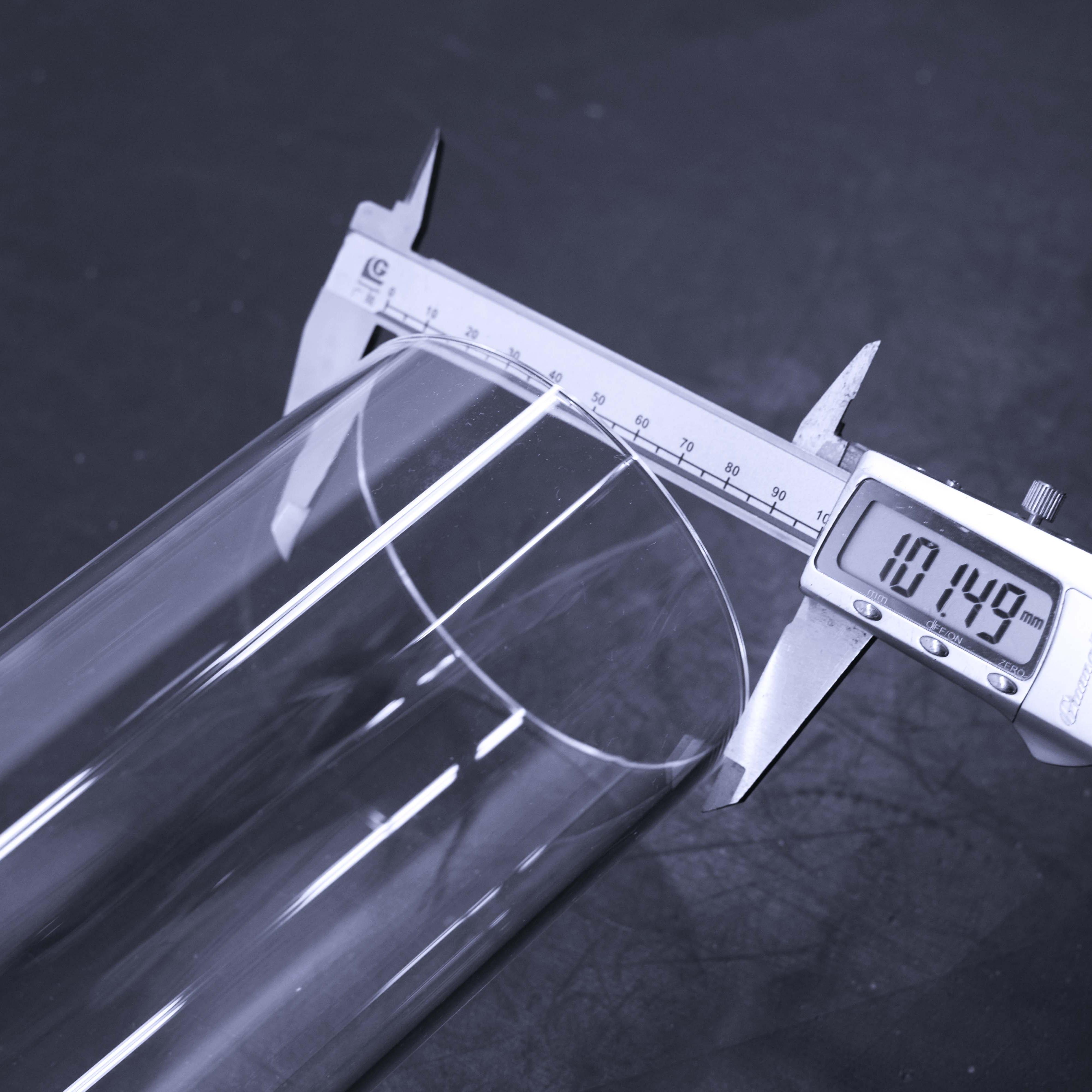
High Purity Quartz Transparent Polished Glass Tube
Purity: ≥ 99.99% SiO₂
Forming: Bending & flange customizable
Feature: High thermal shock stability
View Specifications
From one-piece custom prototypes to recurring production batches: browse our hot-selling quartz tubes, optical plates, reaction vessels, and thermal-process components manufactured with 99.99% to 99.999% SiO₂ purity.


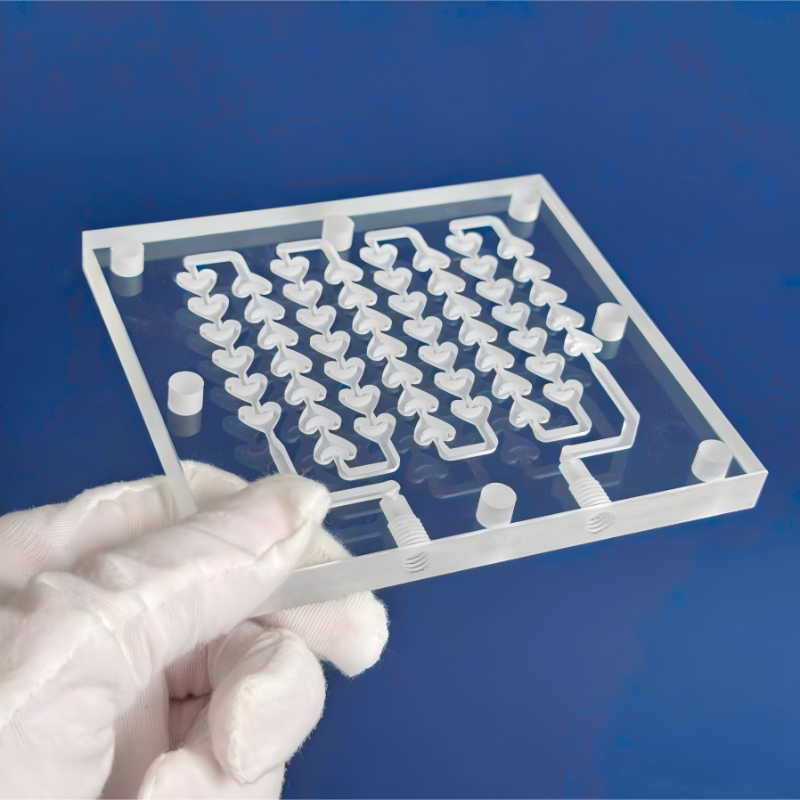
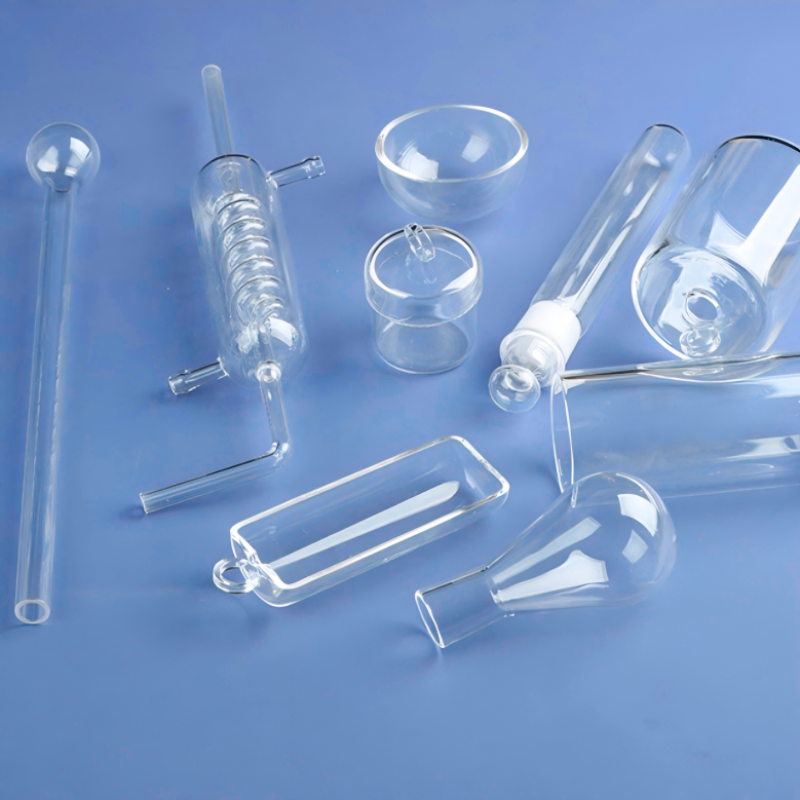
In high-precision optical, laser, and semiconductor applications throughout Greater Glasgow and the Scottish Central Belt, selecting the correct quartz substrate requires rigorous comprehension of hydroxyl radical concentration ([OH⁻]), bubble class categorization, and laser-induced damage thresholds (LIDT).
| Substrate Classification | Material Origin & Synthesis | Spectral Range (T > 80%) | OH⁻ Content | Typical Glasgow Industrial Use Case |
|---|---|---|---|---|
| JGS1 (Synthetic Fused Silica) | Chemical vapor synthesis (SiCl₄ oxidation) | 185 nm – 2500 nm (Deep UV-VIS) | < 5 ppm (or high-OH UV-grade) | Excimer lasers, semiconductor lithography, quantum ion traps |
| JGS2 (Fused Quartz) | High purity natural crystal sand (Donghai) | 220 nm – 2800 nm (Standard Optical) | < 30 ppm | UV curing windows, high-temp sight glasses, lab spectrophotometers |
| JGS3 (Infrared Fused Quartz) | Electric vacuum furnace melted silica | 260 nm – 3500 nm (Near-to-Mid IR) | < 5 ppm (Water-free peak at 2.73μm) | FTIR spectroscopy, thermal imaging pyrometry, subsea sensors |
| Optical Borosilicate (BK7/B270) | Standard multi-component glass | 330 nm – 2100 nm (No Deep UV) | N/A | General instrumentation (Limited ≤ 450°C service) |
Our optical quartz plates undergo planetary double-side chemical-mechanical planarization (CMP). We routinely achieve surface figures of λ/4 to λ/10 at 632.8 nm, with micro-roughness Ra < 0.5 nm and scratch-dig specifications reaching 20-10 or 10-5 per MIL-PRF-13830B for critical laser cavity optics.
With an extraordinarily low thermal expansion coefficient of 5.5 × 10⁻⁷/K, our quartz plates withstand thermal shocks from 1100°C directly down to room temperature without micro-fracturing. For pulsed Nd:YAG laser systems, raw JGS1 optical blanks demonstrate LIDT exceeding 10 J/cm² at 1064 nm (10 ns pulse width).
Manufactured in strict adherence to European standards, our plates undergo spectrophotometric transmission tests, ultrasonic thickness mapping, and polarimetric stress birefringence verification (≤ 5 nm/cm). Certificates of Conformity (CoC) accompany every shipment bound for Glasgow and UK customs.
The Clyde Valley and Central Scotland corridor represent one of Europe's dense concentrations of photonics research and quantum technology commercialization. Our optical quartz plates provide the structural and transmissive foundation for critical regional developments.
Glasgow is a central node in the UK National Quantum Technology Programme, anchored by the University of Glasgow's James Watt Nanofabrication Centre and Strathclyde's optics groups. Our non-magnetic, ultra-low birefringence JGS1 quartz plates serve as optical viewport windows for ultra-high vacuum (UHV) cold-atom chambers, magneto-optical traps (MOT), and quantum optical sensors requiring negligible wavefront distortion.
Leveraging Glasgow's historic maritime and naval engineering legacy along the River Clyde, modern subsea defense and offshore energy inspection systems utilize downhole spectroscopy and LIDAR bathymetry. Our high-strength, chemically resistant polished quartz plates function as deep-water optical windows capable of enduring hydrostatic pressure loads while maintaining 90%+ transmissive clarity.
Clustered around the Queen Elizabeth University Hospital and Glasgow's bio-corridor, clinical research relies on high-resolution fluorescence microscopy, flow cytometry, and microfluidic gene sequencing. Vulra Quartz manufactures custom micro-machined quartz chips and coverslips with near-zero autofluorescence in the ultraviolet excitation bands, eliminating background optical noise.
Scotland's Central Belt is a global manufacturing base for solid-state and fiber lasers. System integrators require fused quartz debris shields, beam splitters, and output window plates that exhibit virtually zero thermal lensing under multi-kilowatt CW continuous-wave laser loads, protecting expensive focus heads from weld spatter and particulate degradation.
Glasgow constructs more small satellites (CubeSats) than any other European city. For Earth observation optical payloads, star trackers, and inter-satellite laser communications (ISL), our thermal-expansion-immune optical quartz plates serve as solar-blind filters, solar cell covers, and front-aperture optical windows designed to endure severe ionizing cosmic radiation without solarization.
Research facilities in Strathclyde exploring green hydrogen flame kinetics and high-temperature thermal storage utilize our optical observation ports. Quartz plates withstand aggressive combustion environments and cyclic thermal gradients up to 1100°C, providing optical access for non-intrusive planar laser-induced fluorescence (PLIF) diagnostics.
Strategic transitions across Scotland's National Manufacturing Institute Scotland (NMIS) and the Scottish Photonics Group dictate the next generation of quartz specifications.
As semiconductor research in the West of Scotland pivots to higher density wafer fabrication and next-gen nanolithography, standard fused quartz (natural sand) is being superseded by synthetic fused silica (JGS1 / Suprasil equivalent). The near-elimination of trace metal contaminants (Fe, Cu, Ti < 0.1 ppm) guarantees transmission at the 193 nm ArF excimer line and prevents long-term solarization under repetitive high-energy UV dosing.
Glasgow's thriving analytical chemistry sector is demanding hybrid quartz plates featuring CNC-milled micro-channels, stepped counterbores, and polished interior surfaces. Cold machining using 5-axis diamond ultrasonic tooling enables channel geometries down to 100 μm without edge chipping, providing microfluidic researchers with chemically inert platforms that tolerate aggressive organic solvents and high internal pressures.
In line with Scottish Enterprise sustainability mandates, OEM equipment builders are prioritizing high-durability quartz consumables that offer extended mean time between failures (MTBF). By integrating vacuum-electric fusing with controlled annealing, Vulra Quartz plates and tubes resist surface devitrification (crystallization into cristobalite) up to 1150°C, significantly reducing material consumption cycles.
Every custom quartz substrate order dispatched to Glasgow traverses our controlled five-stage quality corridor:
Spectroscopic impurity testing of Donghai silica or synthetic boules.
Diamond wire sawing for tight thickness and zero kerf taper.
Double-side CMP pitch polishing to achieve Ra < 0.5 nm finish.
Furnace thermal cycle to remove internal strain (≤ 5 nm/cm).
Interferometric, bubble, and dimensional check; vacuum sealed.
Positioned directly at No. 9 Dingxin Road in Donghai County—the globally acknowledged crystal capital of China—Lianyungang Vulra Quartz Products Co., Ltd. combines an indigenous raw crystal supply chain with internationally verified manufacturing standards.
Our production plant, business standing, and custom fabrication capabilities have been independently inspected and authenticated on-site by TÜV Rheinland. We operate transparently with documented factory capacities, verified trade ratings, and audited quality management protocols.
University labs and exploratory R&D teams often require single bespoke plates or proof-of-concept furnace boats. Unlike volume-restricted suppliers, Vulra Quartz supports low-barrier innovation: send your DXF, DWG, or STEP file, and our engineering desk will review and produce from MOQ 1 piece.
Fragile quartzware demands specialized transit packaging. Every plate, tube, and crucible is wrapped in acid-free barrier films, nestled in custom high-density EPE foam chambers, and boxed in reinforced multi-wall cartons or fumigated wooden crates engineered for secure air and sea freight into Glasgow Airport (GLA) or the Port of Grangemouth.
Submit your tolerance requirements, spectral transmission needs, or CAD drawings directly to our technical sales team for an engineering review and DDP Glasgow quotation within 24 hours.
Straightforward technical answers addressing compliance, customs, mechanical tolerances, and material performance for Scottish procurement officers and laboratory engineers.