Selecting the top Fused Silica Quartz Tube suppliers worldwide requires more than comparing prices or catalog photographs. These tubes support semiconductor processing, laboratory furnaces, photovoltaic production, optical equipment, and chemical applications. Each sector demands different thermal, chemical, and dimensional performance.
Industry reports show why supplier evaluation matters. SEMI’s World Fab Forecast continues to document expanding global semiconductor manufacturing capacity, increasing demand for contamination-controlled quartz components. Grand View Research also identifies rising semiconductor and solar manufacturing activity as key drivers for the broader quartz market. However, market reports often combine raw quartz, engineered parts, and finished tubes. Their figures are useful, but not perfectly comparable.
Technical evidence should guide the shortlist. Reliable suppliers should disclose silica purity, hydroxyl content, bubble grade, wall-thickness tolerance, working temperature, and inspection methods. A tube used near 1,100°C cannot be judged by appearance alone. Under bright light, tiny striae or bubbles may become visible. In a clean furnace, those defects can affect process stability.
Experience still matters. Ask whether the supplier supports custom diameters, flanges, closed ends, and repeat production. Request material certificates and sample inspection records. ASTM C829 provides recognized approaches for inspecting fused silica ware, although application-specific standards may also apply. No supplier is perfect. Lead times, packaging, and communication can fail unexpectedly. This guide therefore compares global suppliers through technical capability, quality evidence, production consistency, customization, and service reliability. The strongest choice is not always the largest company. It is the supplier that can repeatedly deliver the right tube for the right process.
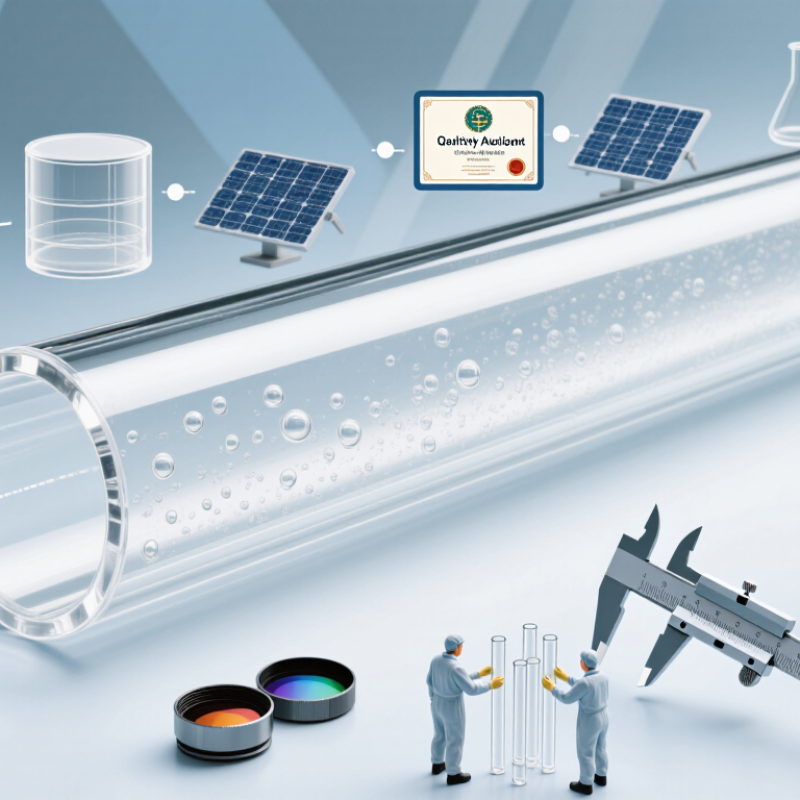
Fused silica quartz tubes are hollow components made from high-purity silicon dioxide. Unlike ordinary glass, fused silica has an amorphous structure and contains very few impurities. It is not glass. Manufacturers melt silica, form it into a tube, and control its dimensions through heating and machining. The result is a clear or translucent tube with strong thermal stability, low expansion, and excellent resistance to many chemicals.
These tubes are widely used in laboratory furnaces, ultraviolet equipment, analytical instruments, and high-temperature processing systems. A quality tube can tolerate rapid temperature changes better than many ceramic or glass alternatives. However, it is not indestructible. Strong alkalis, hydrofluoric acid, surface scratches, and uneven heating can cause premature failure. Small flaws matter.
When evaluating worldwide suppliers, engineers should request the outer diameter, inner diameter, wall tolerance, silica purity, surface finish, and operating temperature. Material certificates and inspection records also improve reliability. In practical use, clean handling is essential because fingerprints can leave residues after heating. One overlooked issue is thermal contact with metal supports; concentrated pressure may crack the tube during cycling. Supplier selection should therefore consider process knowledge, traceability, packaging quality, and technical communication, not only price. A careful trial run remains valuable, because published specifications may not reflect every furnace design or working condition.
Fused silica quartz tubes support demanding thermal processes across semiconductor, photovoltaic, laboratory, and optical manufacturing. Their low thermal expansion reduces cracking during rapid temperature changes. High-purity grades also limit metallic contamination inside process chambers. This matters during wafer diffusion, oxidation, and deposition cycles.
The semiconductor industry remains a major application. The World Semiconductor Trade Statistics forecast global chip sales at about US$588 billion in 2024. That expansion increases demand for reliable furnace components, including quartz tubes, boats, and liners.
Photovoltaic production is another large user. The International Energy Agency reported roughly 420 gigawatts of new solar photovoltaic capacity in 2023. Diffusion and annealing equipment often requires transparent, heat-resistant quartz components. Solar factories also value consistent tube dimensions during continuous production.
Laboratories use smaller tubes for chemical vapor deposition, thermal analysis, and high-temperature experiments. Optical fiber facilities need clean silica environments during preform processing. Tube performance depends on wall thickness, hydroxyl content, surface finish, and temperature uniformity. Supplier audits should examine traceability, cleaning methods, dimensional inspection, and replacement lead times. A lower price can become expensive when one warped tube interrupts a furnace schedule.
A practical limitation deserves attention. Public market reports rarely separate fused silica tubes from broader quartz products. Therefore, application forecasts should be treated as directional, not exact. Experienced buyers should verify data through production trials, impurity certificates, and thermal cycling tests before approving global suppliers.
Choosing global fused silica quartz tube suppliers requires more than comparing prices. Start with the tube’s intended use, such as laboratory heating or high-temperature equipment. Each application demands different purity, wall thickness, diameter tolerance, and hydroxyl content. Ask suppliers for material specifications, inspection records, and thermal performance data. Do not accept vague terms like “premium grade.” Ask for evidence. A reliable supplier should explain batch control and defect detection methods.
Evaluate manufacturing experience through sample quality and technical communication. Request a sample matching your planned geometry. Inspect transparency, bubbles, devitrification, scratches, end finishing, and straightness under suitable lighting. Compare the inspection report with your own measurements. This step can reveal gaps between promises and production reality. One sample cannot represent every batch. Still, it reduces avoidable risk. Confirm whether the supplier can maintain tolerances during repeat production.
Tips: Review traceability, packaging, lead times, replacement procedures, and shipping documents before payment. Confirm whether required certificates come from recognized independent laboratories. Ask for references from comparable industrial users. Protect confidential information. Clear answers matter. Slow replies may signal weak support, though not always. Global sourcing also requires checks on customs classifications, insurance, and damage claims. Choose a supplier that documents limitations honestly. That is often more valuable than polished marketing.
Top Fused Silica Quartz Tube Suppliers Worldwide?
Supplier strength varies by region and manufacturing depth. China has broad production capacity, competitive tooling, and flexible custom sizes. Germany and Japan are often recognized for tight dimensional control and disciplined quality systems. The United States supports advanced laboratory, semiconductor, and optical applications. Europe also offers experienced fabricators for specialized thermal assemblies. Regional reputation helps, but it does not replace factory evidence.
Capable manufacturers control the full process, from high-purity raw material selection to electric fusion, tube forming, cutting, polishing, and annealing. Strong facilities can maintain stable wall thickness, low bubble levels, and clean internal surfaces. Some provide CNC machining, flanged ends, drilled openings, or custom bends. Inspection records should include dimensions, visual defects, surface quality, and thermal performance. I have found that communication speed matters too. A technically capable supplier may still fail when drawings are unclear. No region is perfect.
Tips: Request a recent inspection report and a production sample. Confirm purity, tolerance, operating temperature, and packaging methods. Ask whether testing occurs in-house or through an external laboratory. Compare lead times for prototypes and repeated orders. A useful supplier should explain limitations honestly, not promise every specification. Small details matter.
Choosing a fused silica quartz tube supplier requires more than comparing prices. The U.S. Geological Survey’s Mineral Commodity Summaries 2024 reports continued global demand for industrial sand and silica materials, increasing pressure on consistent raw-material quality. Ask where the silica originates, how it is purified, and whether each batch has a traceable certificate. Traceability matters.
Thermal performance should match the application. Request data for hydroxyl content, impurity levels, wall tolerance, softening point, and thermal-shock resistance. A supplier should provide inspection records, not only a polished brochure. ISO 9001 certification can indicate controlled processes, while ISO/IEC 17025 accreditation supports confidence in laboratory testing. Still, certification alone is not proof of excellent tubes. Ask for recent test results from the actual production line.
Manufacturing experience becomes visible in small details. Check whether tube ends are fire-polished, whether the inner surface contains haze, and whether dimensions remain stable after repeated heating cycles. Request samples cut to your required length and test them in your own furnace. That gap matters. A tube that survives one heating cycle may fail after months of use. Delivery capacity also deserves scrutiny; confirm minimum order quantities, replacement procedures, packaging methods, and lead times in writing. Industry outlook reports from Grand View Research and similar analysts indicate steady growth in specialty glass demand, but market growth does not guarantee dependable service. I would rather choose a slightly costlier supplier with clear data than a cheaper source that avoids difficult questions.
| Evaluation Factor | Relevant Technical Benchmark | Why It Matters | Evidence to Request | Suggested Weight |
|---|---|---|---|---|
| Silica Purity | High-purity fused silica tubes commonly target approximately 99.99% to 99.999% SiO₂, depending on the manufacturing route and grade. | Metallic impurities can affect semiconductor processing, optical transmission, chemical resistance, and high-temperature stability. | Lot-specific chemical analysis, material certificate, and stated impurity limits for Al, Fe, Na, K, Ca, Mg, and Li. | 20% |
| Operating Temperature | Fused silica has a softening point of approximately 1,660–1,710°C; practical continuous-use temperature depends on load, atmosphere, geometry, and thermal cycling. | The tube must withstand the actual process temperature without deformation, devitrification, or premature failure. | Published temperature limits, application history, thermal-cycle data, and recommended atmosphere conditions. | 15% |
| Thermal Expansion | The average coefficient of thermal expansion is about 0.5–0.6 × 10⁻⁶ K⁻¹ over a typical room-temperature range. | Very low expansion supports strong thermal-shock resistance and helps maintain dimensional stability during rapid heating and cooling. | Material datasheet showing the test range, measurement method, and grade-specific expansion value. | 10% |
| Dimensional Accuracy | Tolerance should be agreed for outside diameter, inside diameter, wall thickness, length, roundness, and straightness; exact limits depend on tube size and forming method. | Accurate dimensions are essential for furnace fitting, seals, heaters, thermocouples, fluid flow, and automated assembly. | Approved drawing, inspection plan, sample measurement report, and calibrated measuring equipment records. | 15% |
| Surface Quality | The required finish may be fire-polished, ground, honed, or optically polished; surface roughness and edge condition should be specified by application. | Surface defects may increase contamination, reduce optical performance, create stress concentrations, or interfere with sealing. | Visual inspection criteria, roughness values where applicable, edge-condition requirements, and representative inspection photos. | 10% |
| Bubbles, Inclusions, and Devitrification | Acceptable defect levels should be defined by grade and application; optical and semiconductor uses generally require stricter limits than general laboratory heating applications. | Internal defects can weaken the tube, scatter light, introduce contamination, and reduce service life under thermal stress. | Inspection standard, defect-size limits, batch inspection records, and acceptance samples. | 10% |
| Chemical Compatibility | Fused silica offers strong resistance to many acids and halogens, but it can be attacked by hydrofluoric acid and hot concentrated alkaline solutions. | Compatibility determines whether the tube will remain stable in wet, corrosive, vacuum, or reactive-gas processes. | Chemical compatibility statement, application-specific test results, and recommended restrictions. | 10% |
| Hydroxyl (OH) Content | OH content varies by manufacturing process and grade; low-OH material is commonly selected for infrared transmission and some high-temperature applications. | Hydroxyl groups influence infrared absorption, outgassing behavior, and performance in vacuum or optical systems. | OH-content specification, infrared transmission curve, and batch test report. | 5% |
| Quality Management and Traceability | A documented quality system, commonly certified to ISO 9001, should support material traceability, nonconformance control, calibration, and corrective action. | Consistent records reduce batch-to-batch variation and simplify audits, complaint handling, and regulated procurement. | Current certificate, audit summary, lot-number system, calibration records, and sample certificate of conformity. | 5% |
| Customization and Engineering Support | Available options may include cut-to-length tubes, flanges, slots, holes, fire-polished ends, ground ends, bends, and welded or fused assemblies. | Design support can reduce development time and prevent failures caused by incorrect tolerances, thermal stress, or unsuitable processing. | Technical drawing review, prototype capability, engineering change procedure, and sample approval process. | 5% |
| Packaging and International Logistics | Packaging should prevent impact, abrasion, moisture exposure, and particulate contamination; export documents should match the destination country’s requirements. | Quartz tubes are brittle and can incur hidden costs through breakage, delays, customs problems, or inadequate protective packaging. | Packaging specification, drop or transport testing where required, Incoterms, lead time, export documents, and insurance options. | 5% |
| Total Suggested Evaluation Weight | 100% | |||
Note: Technical values are typical reference ranges for fused silica or high-purity quartz products. Final acceptance limits should be confirmed against the supplier’s grade-specific datasheet, approved drawing, and application conditions.
They are hollow components made from high-purity silicon dioxide. The material has an amorphous structure. It contains very few impurities. It is not ordinary glass.
They offer strong thermal stability and low thermal expansion. They handle rapid temperature changes better than many glass alternatives. Uneven heating can still cause damage. They are not indestructible.
Common uses include laboratory furnaces, ultraviolet equipment, and analytical instruments. They also support semiconductor, solar, optical, and thermal processing. Small tubes suit laboratory experiments. Large tubes suit furnace systems.
Check the outer diameter, inner diameter, and wall tolerance. Confirm silica purity, surface finish, and operating temperature. Request material certificates and inspection records. Small dimensional errors can disrupt furnace operation.
Strong alkalis and hydrofluoric acid can attack the material. Surface scratches may grow during heating cycles. Uneven heating creates internal stress. Metal supports can apply concentrated pressure. Small flaws matter.
Use clean gloves to avoid fingerprints and residue. Inspect the inner surface under clear lighting. Check for chips, scratches, bubbles, or warped sections. Avoid hard contact with metal fixtures. Clean handling matters.
Several manufacturing regions offer different strengths. Some provide flexible custom sizes and competitive tooling. Others focus on tight dimensions and disciplined quality systems. Regional reputation helps, but factory evidence matters more.
Request a recent inspection report and a production sample. Confirm testing methods, traceability, packaging, and replacement lead times. Ask whether testing occurs internally or externally. Technical communication matters. No supplier is perfect.
Treat specifications as useful guidance, not absolute proof. A trial run can reveal furnace-specific problems. Test thermal cycling, dimensions, cleanliness, and impurity levels. Published data may not reflect every working condition. Reality can surprise you.
Fused Silica Quartz Tube is a high-purity component made from silicon dioxide, valued for its excellent thermal resistance, chemical stability, optical clarity, and low thermal expansion. These properties make it suitable for demanding applications such as semiconductor processing, laboratory equipment, high-temperature furnaces, ultraviolet light systems, analytical instruments, and specialized heating assemblies. The right tube can improve process reliability, energy efficiency, and product consistency in environments involving extreme temperatures or corrosive substances.
When evaluating global suppliers, buyers should consider raw material purity, dimensional accuracy, wall thickness control, customization capability, production capacity, quality inspection, packaging, and delivery performance. Leading manufacturing regions may differ in their strengths, including advanced processing technology, large-scale production, or flexible small-batch manufacturing. A dependable supplier should provide clear technical specifications, consistent quality documentation, responsive communication, and practical support throughout sampling, production, and shipment. Comparing total value rather than price alone helps purchasers select a supplier that matches their application, budget, performance requirements, and long-term sourcing plans.