China has become an important sourcing destination for high-quality Clear Quartz Rod products. Its manufacturers serve laboratories, semiconductor facilities, optical equipment companies, and industrial heating applications. However, supplier selection requires more than comparing prices.
Dr. John E. Shelby, a respected glass-science author, has emphasized that “fused silica combines exceptional purity with very low thermal expansion.” This principle remains central when evaluating quartz rods. Buyers should examine silica purity, hydroxyl content, diameter tolerance, surface finish, and thermal-shock resistance. These details influence performance under intense heat. Small defects can matter.
A dependable Chinese manufacturer should provide material specifications, inspection records, batch traceability, and realistic production tolerances. Clear communication also matters. Drawings, sample approvals, packaging details, and delivery schedules should be confirmed before production. Some suppliers offer custom lengths, polished ends, drilled holes, or special diameters. Their actual capability must be verified through samples and technical documents.
No supplier is perfect. Even an experienced factory may face variation between batches. That deserves honest attention. A strong purchasing decision combines factory experience, engineering knowledge, transparent evidence, and independent quality checks. This guide examines China’s leading Clear Quartz Rod manufacturers and suppliers through those practical standards. It focuses on measurable performance, not attractive claims alone.
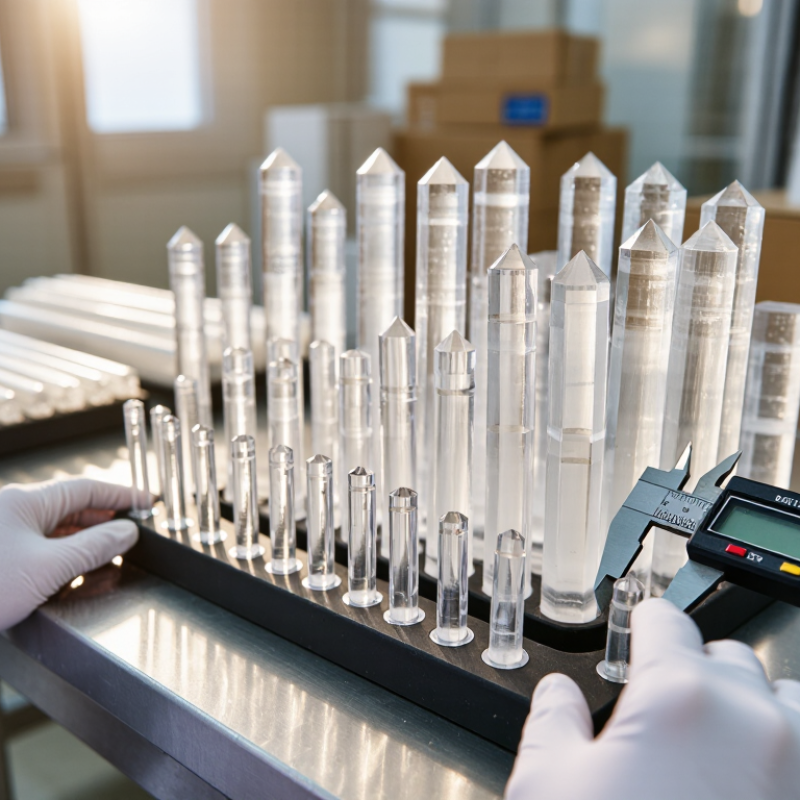
Clear quartz rods are made from high-purity silica and are valued for their clean appearance, low thermal expansion, and strong chemical resistance. They tolerate sudden temperature changes better than many ordinary glasses. Their working temperature can exceed 1,000°C, depending on design and operating conditions. They also transmit ultraviolet light, but transmission depends strongly on purity and manufacturing control.
Grades are usually separated by purity, hydroxyl content, optical quality, and dimensional tolerance. Industrial-grade rods may contain small bubbles or visible striae. Optical-grade rods require better transparency and fewer internal defects. Semiconductor and laboratory applications often demand tighter tolerances and controlled surface finishes. A useful warning: clear does not always mean optically perfect. This distinction is often missed. Inspectors should check diameter, straightness, end polish, inclusions, and surface scratches. Requesting inspection records is sensible, although records alone cannot replace physical sampling.
Common applications include laboratory reaction systems, UV lamp supports, heating equipment, sight windows, and high-temperature fluid handling. Quartz rods are also used in optical assemblies and some semiconductor processing tools. Their low expansion helps reduce stress during heating and cooling. However, repeated contamination, uneven heating, or mechanical impact can still cause failure. It is tempting to choose a rod by appearance alone, but that is a weak method. Match the grade to wavelength, temperature, chemical exposure, and load. Supplier communication matters too. Confirm tolerances before production, because a small diameter error can affect assembly alignment and heating performance.
Clear quartz rods are made from high-purity silica, not ordinary glass. Chinese factories usually begin by checking the raw material for metal impurities, bubbles, and moisture. The silica is melted in a controlled furnace at extremely high temperatures. Operators then form the molten quartz into tubes or solid rods. Diameter control matters here. Even a small variation can affect sealing, heating, or laboratory performance.
After forming, the rods pass through cutting, grinding, and polishing stages. Diamond tools help create clean ends and stable dimensions. Some manufacturers use thermal treatment to reduce internal stress. Each batch should receive visual inspection and dimensional testing. Experienced quality teams also check transmission, surface scratches, and contamination under strong lighting. The process is precise, though not flawless. Occasional micro-cracks may appear after cooling and require rejection.
Tips: Ask suppliers for dimensional tolerances, inspection records, and material reports. Confirm whether the rod is fused, polished, or flame-finished. Request sample pieces before placing a large order. Check the ends closely; they should look even, smooth, and free from chips. Packaging also matters. Foam sleeves and separate compartments can prevent impact damage during international transport. A reliable supplier should explain its furnace control, inspection tools, and corrective procedures clearly.
China Best Clear Quartz Rod Manufacturers and Suppliers
Key Standards for Evaluating Chinese Quartz Rod Manufacturers
Selecting a Chinese quartz rod manufacturer starts with measurable process control, not catalog photos. Ask for raw-material origin, SiO2 purity, hydroxyl content, and metallic impurities. Request batch-level certificates, not a generic laboratory sheet. ASTM C146 supports chemical analysis of glass sand, while ISO 9001 supports documented quality systems. Neither standard alone proves rod performance.
Dimensions must remain stable after heating. Check outside diameter, wall thickness, straightness, surface bubbles, devitrification, and working-temperature data. For laboratory and semiconductor applications, request thermal expansion results and a defined inspection method. The 2024 USGS Mineral Commodity Summaries estimated U.S. industrial sand and gravel output near 100 million metric tons in 2023. That figure shows raw-material scale, not finished-rod quality. That distinction matters.
A reliable supplier should provide sample measurements, calibration records, and corrective-action reports. Review packing details, including capped ends, shock protection, moisture control, and traceable labels. Audit communication speed too. Production problems rarely wait for email. Keep records. I would compare three samples under the same furnace cycle. One clean sample proves little. A low price may reflect efficient processing or hidden inspection limits. I have seen precise specifications without tolerance bands. Not enough. Buyers should confirm export documents and local conformity requirements before payment. Even experienced teams miss small details.
| Evaluation Dimension | Recommended Reference Data | What to Verify | Relevant Standard or Document |
|---|---|---|---|
| Quartz Material Type | Transparent fused quartz or fused silica; the material description should clearly distinguish it from borosilicate glass. | Material name, manufacturing process, raw-material source, and product technical datasheet. | Customer specification and approved technical drawing. |
| Silica Purity | Common commercial grades include 99.95% and 99.99% SiO₂. The supplier must state whether the value is nominal, minimum, or test result. | Lot-specific certificate of analysis, impurity list, analytical method, and detection limits. | Customer specification; chemical analysis method should be identified in the inspection report. |
| Metallic Impurities | For high-purity applications, request quantified limits for Al, Fe, Na, K, Ca, Mg, Ti, Cu, and Li rather than relying only on a general purity percentage. | ICP-OES, ICP-MS, or another documented analytical method; check whether results are reported by mass fraction. | ASTM C146 may be used for chemical analysis of glass sand where applicable; the agreed product specification remains controlling. |
| Outside Diameter | Typical ordered diameters may range from approximately 1 mm to 50 mm, subject to the production process and drawing requirements. | Measured diameter at multiple points along the rod; confirm the tolerance stated on the quotation and drawing. | Customer drawing; use calibrated micrometers or optical measuring equipment. |
| Length and Length Tolerance | Commercial cut lengths commonly range from short laboratory pieces to approximately 2,000 mm; exact limits depend on equipment and packaging. | Actual length, squareness of cut ends, end chipping, and consistency between samples. | Approved drawing and purchase specification. |
| Dimensional Consistency | Diameter variation should be controlled according to the application; critical optical or laboratory assemblies normally require tighter tolerances than general-purpose tubing or support parts. | Inspection plan, sampling frequency, control charts, and calibration records. | ISO 9001 quality-management procedures and customer-defined tolerances. |
| Visual Clarity | Clear appearance with no unacceptable bubbles, stones, devitrification, cracks, black particles, or visible contamination. | Written visual acceptance criteria, inspection lighting, sample photos, and defect classification. | Customer-approved visual standard and inspection procedure. |
| Surface Quality | Surface should be free from deep scratches, pits, grinding marks, residue, and handling contamination unless a ground or polished finish is specifically requested. | Surface-finish grade, roughness requirement where applicable, cleaning process, and final inspection records. | Customer drawing and agreed surface-finish specification. |
| Thermal Resistance | Fused quartz has a softening point of approximately 1,680°C and a low coefficient of thermal expansion of about 0.5 × 10⁻⁶ K⁻¹ over a commonly cited temperature range. | Confirm the exact grade, test temperature range, thermal-shock conditions, and whether the data are typical or guaranteed. | Supplier technical datasheet and customer application requirements. |
| Thermal Shock Performance | The acceptance temperature difference must be defined by the application; no universal thermal-shock value should be assumed for every rod geometry. | Test method, specimen geometry, heating and cooling rates, number of cycles, and failure criteria. | Application-specific test protocol agreed before production. |
| Dimensional Stability at Temperature | The supplier should provide service-temperature guidance and identify risks such as deformation, devitrification, or contamination during prolonged heating. | Heating-cycle results, maximum recommended operating temperature, and furnace-atmosphere conditions. | Application test report and approved technical specification. |
| Optical Transmission | Transmission depends on grade, diameter, surface condition, and wavelength. A wavelength-specific transmission curve is more useful than a single general transparency claim. | Spectrophotometer data, test thickness, wavelength range, and measurement conditions. | Customer optical specification and laboratory test report. |
| Electrical Insulation | For electrical or high-frequency use, request dielectric-strength, dielectric-constant, and dissipation-factor data at the intended temperature and frequency. | Test frequency, temperature, electrode arrangement, specimen dimensions, and conditioning procedure. | Application-specific electrical test standard and customer specification. |
| Cleanliness and Packaging | Each rod should be protected against impact, moisture, dust, and metal-to-glass contact during shipment. | Cleaning method, protective sleeves, separator material, carton strength, and packing photographs. | Approved packaging specification and shipping requirements. |
| Traceability | Every shipment should be linked to a production lot, inspection date, raw-material batch, and certificate of analysis. | Lot number on packaging, inspection report, retained samples, and documented nonconformance process. | ISO 9001 quality-management practices. |
| Quality Management System | A documented quality system should cover incoming materials, process control, calibration, final inspection, corrective action, and customer complaints. | Valid certificate, certification scope, certificate number, issuing body, and audit status. | ISO 9001:2015. |
| Environmental and Regulatory Compliance | For international shipments, confirm applicable restrictions on hazardous substances and chemical substances based on the destination market. | Declaration of conformity, material disclosure, and supporting test reports where required. | ISO 14001:2015, EU RoHS Directive 2011/65/EU and amendment (EU) 2015/863, and REACH Regulation (EC) No 1907/2006 where applicable. |
| Sampling and Pre-Shipment Inspection | Use a written sampling plan covering dimensions, appearance, purity, packaging, and labeling before shipment. | Inspection level, acceptance criteria, randomization method, inspection photos, and corrective-action records. | ISO 2859-1 may be used as a framework for attribute-sampling plans when agreed by the buyer and supplier. |
| Technical Communication | The supplier should provide English technical documents with units, tolerances, test conditions, revision numbers, and clear distinction between typical and guaranteed values. | Drawing review, pre-production sample approval, response time, engineering change notification, and document control. | ISO 9001 document-control practices and purchaser-supplier agreement. |
Selecting a reliable clear quartz rod supplier requires more than comparing prices. In laboratory and semiconductor work, small defects can cause large process losses. SEMI reported global semiconductor materials sales of about US$67.1 billion in 2023. This reflects the strict expectations placed on process materials, including quartz components.
Ask suppliers for raw material origin, purity data, hydroxyl content, and inspection records. A dependable manufacturer should provide dimensional tolerances, surface-finish values, and test results for bubbles, inclusions, and devitrification. Request a sample before placing a large order. Check whether the rod remains stable after repeated heating and cooling. ISO 9001 certification helps, but it does not prove every rod is suitable. I have found that traceability is often more useful than polished marketing language.
Tips: Compare the same specifications. Confirm diameter, length, tolerance, and packaging in writing. Ask for a recent certificate of analysis, not a generic template. Review the supplier’s response speed and technical questions. A supplier that asks about furnace temperature, atmosphere, and loading conditions usually understands real applications. Still, no supplier is perfect. Even careful inspection may miss a weakness that appears during thermal cycling. Therefore, define acceptance criteria before production and keep a retained sample for future comparison. Reliable communication, consistent testing, and honest limitations matter more than the lowest quotation.
When evaluating a clear quartz rod supplier, compare documented material purity, dimensional control, hydroxyl content, temperature performance, and traceability. The values below are representative technical benchmarks commonly used for fused silica and quartz rod procurement; exact specifications vary by grade and manufacturing process.
Purchasing clear quartz rods requires more than comparing prices. The USGS Mineral Commodity Summaries 2024 identifies industrial sand and gravel as major silica commodities, but rod-grade specifications vary by application. Ask suppliers for raw-material origin, SiO₂ purity, hydroxyl content, and production tolerances. A reliable supplier should provide batch traceability and a clear certificate of analysis.
Customization should begin with drawings, not informal messages. Define diameter, length, end shape, surface finish, straightness, and acceptable bubbles or striae. For high-temperature equipment, request thermal-shock testing and annealing details. For optical use, confirm transmission data at the intended wavelength. ISO 9001 certification supports process control, but it does not guarantee perfect quartz. That distinction is often missed.
Tips: Request three samples from different batches. Measure diameter at several points with calibrated equipment. Inspect under strong side lighting. Check for cracks, cloudy zones, and edge chips. Ask for inspection records, not only photographs. ASTM or equivalent test methods should be named in the report. A pre-shipment inspection can compare quantity, packaging, dimensions, and visual quality against the approved sample. Small defects matter. I have seen drawings appear complete while omitting tolerance zones, creating avoidable disputes. Recheck the specification before production begins.
Ask for raw-material origin, silica purity, hydroxyl content, and metallic impurity levels. Request batch-specific certificates. Generic laboratory sheets are not enough.
Check outside diameter, wall thickness, length, straightness, and tolerance bands. Measure several points along each rod. Small changes can affect furnace loading.
Inspect for bubbles, inclusions, scratches, and devitrification. Use clear lighting and photographed samples. One clean surface proves little.
Yes. Compare at least three samples under the same heating cycle. Keep one retained sample for later comparison. Keep records.
Request working-temperature data and thermal-expansion results. Ask how the rod performs after repeated heating and cooling. A single heating test may miss weakness.
No. A documented quality system shows process control, not guaranteed application performance. Confirm actual inspection results and traceability for each batch.
Confirm capped ends, shock protection, moisture control, and traceable labels. Ask for photos of packed samples. Damage can begin before delivery.
Notice response speed and technical questions about temperature, atmosphere, and loading. Useful questions suggest practical experience. Still, communication alone cannot prove quality.
A low quote may reflect efficient production or limited inspection. Compare identical specifications, tests, tolerances, and packaging. Cheap can become expensive.
Confirm acceptance criteria, export documents, and applicable local conformity requirements. Record every specification in writing. Experienced teams still miss small details.
Clear Quartz Rods are valued for their high purity, excellent light transmission, thermal stability, and resistance to chemical corrosion. Available in different grades and dimensions, they are commonly used in laboratory equipment, optical systems, semiconductor processes, heating components, and specialized industrial applications. Understanding the differences between grades, surface finishes, tolerances, and purity levels is essential when selecting the right product for a specific project.
China has developed mature manufacturing capabilities for quartz products, including cutting, forming, polishing, cleaning, and quality testing. When evaluating a Chinese manufacturer or supplier, buyers should consider raw material quality, production experience, dimensional consistency, inspection procedures, customization capabilities, packaging, and delivery performance. Clear technical communication is important for confirming drawings, specifications, allowable tolerances, and testing requirements. Before placing a large order, purchasers should review samples, verify quality documentation, conduct inspections, and establish clear standards for acceptance to ensure reliable performance and long-term cooperation.